

Autonomy • Executable • Scalable
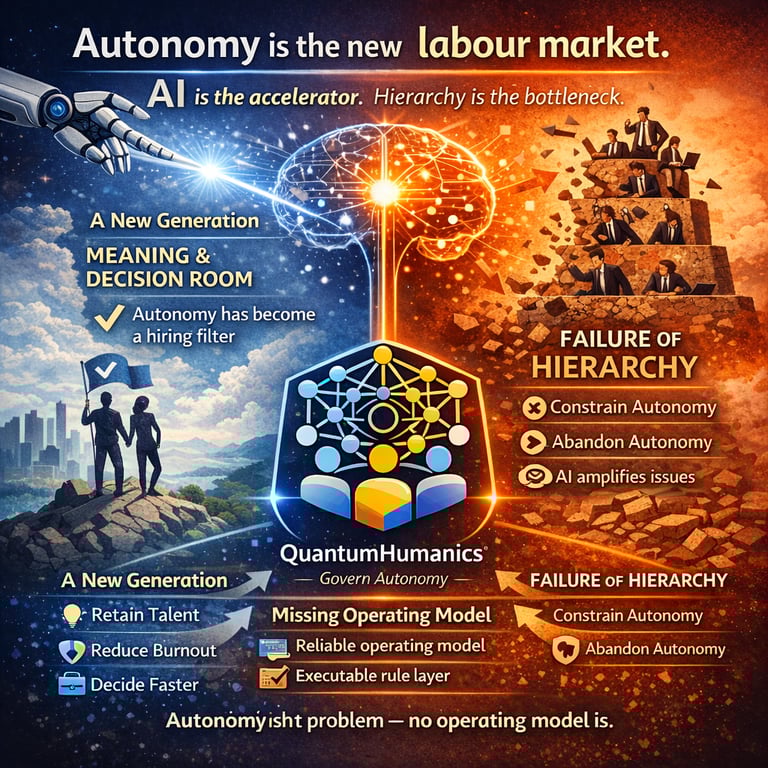
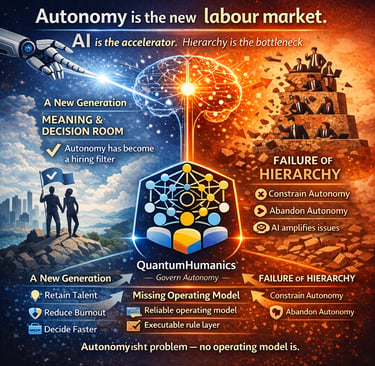
Autonomy is the new labour market. AI is the accelerator. Hierarchy is the bottleneck.
A new generation is entering the workforce with a clear expectation: meaning and real decision-making room. Autonomy has become a hiring filter. At the same time, AI is pushing the pace higher — processes move faster, expectations rise, and mistakes become more visible. Under that pressure, the old operating model starts to crack: more layers, more meetings, more control.
Autonomy isn’t a buzzword. It’s a prerequisite for retaining talent, reducing burnout pressure, and making decisions at speed. Yet in hierarchical systems, autonomy is either constrained (suffocation) or abandoned (chaos). With AI, that tension only intensifies.
Autonomy doesn’t fail because of people. It fails because the operating model is missing.
QuantumHumanics provides what’s missing: a design and operating model (Organihedron) that makes autonomy governable — with Organihedron-led governance, testable boundaries, and an executable rule layer.
Why QuantumHumanics
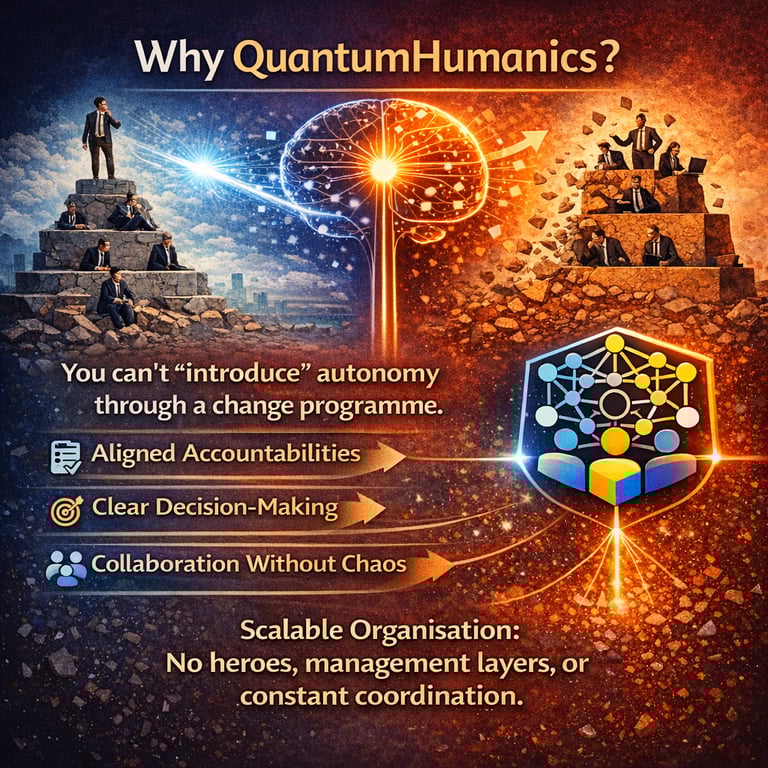
You can’t “introduce” autonomy through a change programme. Autonomy is a structural question. It requires an operating design where accountabilities align, decision-making is clear, and collaboration doesn’t collapse into endless alignment, escalations, and informal power.
QuantumHumanics builds an organisational form that remains scalable: less dependent on heroes, less dependent on management layers, and less dependent on constant coordination.
What we do
1) Organihedron organisational architecture
We design organisations as networks using five building blocks:
nodes (teams, roles, domains)
decorations (attributes, permissions, capabilities, boundaries)
connections (interfaces, handovers, dependencies)
dynamics (cadence, decision-making, escalation, feedback)
amplitudes (scenarios, transitions, growth and stress behaviour)
This turns autonomy from a wish into a design — and coherence from a feeling into a governable principle.
2) Autonomous governance with testable boundaries
We make explicit who decides what, with which information, at what cadence, and within which limits. Not to restrict people, but to enable speed, accountability, and safety without top-down pressure.
3) Proportional holistic value chain
We make visible where value is created, where workload lands, and where risk shifts. Then we design a proportional distribution that is transparent, explainable, and stable. This prevents silent overload and endless coordination.
4) Executable rule layer (ERP/BRMS on Oracle)
Governance rarely fails in PowerPoint. It fails in execution.
That’s why we translate operating principles into executable rules: roles, mandates, decision logic, exceptions, audit trail, and reporting. Autonomy grows not on belief, but on consistency.
5) The human layer: teams, profiles, and coaching
Autonomy requires maturity. We optimise teams for role fit and complementarity, and we support leaders and professionals so the system works not only on paper, but in behaviour and cadence.
We back team and leadership choices with short measurements and profile reports, so decisions don’t have to rely on gut feel.
We also work one-to-one through business coaching and leadership coaching focused on decision strength, role clarity, boundaries, and focus.
Approach
Scan → Pilot → Scale
Scan
In a short time, we reduce the core friction to three design choices: governance, value chain, and execution. We pinpoint where autonomy gets stuck and which boundaries are missing. Where useful, we use short measurements and profile reports to make friction, role fit, and collaboration concrete.
Pilot
We make it real in one domain or chain: boundaries, cadences, decision paths, and the first rule set operate in practice. We see immediately what it resolves and what still grates.
Scale
We expand without adding layers. Embedding happens through operating rules and the platform — not through more management and more meetings.


Platform
Make autonomy executable instead of dependent on agreements in people’s heads.
The platform is a BRMS/ERP control layer built on Oracle development technology, bringing governance into day-to-day execution. It makes rules versioned, consistent, and testable.
What the platform supports
roles and permissions by domain
decision paths, exceptions, and escalation logic
chain processes and handovers
distribution rules for value and workload
audit trail and management information without noise


Who it’s for
For organisations that have had enough of symptom-fixing and layer-building. For example:
health and social care
government and the public/semi-public sector
education and knowledge institutions
professional services, co-operatives, and networks
scaling tech and product organisations
industry and logistics with chain complexity
NGOs and cross-organisational coalitions
scale-ups that want accountability where it belongs
What you get
faster decisions without an escalation culture
more ownership with less coordination work
less friction between teams and chain partners
transparent distribution of value, workload, and accountability
consistent process behaviour without micromanagement
auditability without bureaucratic inflation
About Paul Hager
Paul Hager is a consultant and organisational architect for autonomous organisations. We combine strategy, governance, and execution into a single coherent approach — and translate it into operating rules and systems that hold when pressure rises.
You work directly with Paul on analysis, design, and direction. For specialist delivery such as implementation, integrations, or technical deep dives, we collaborate with a carefully selected network of experienced professionals, while Paul remains accountable for coherence and quality end to end.